The Power of Value: How One MedTech Leader Navigated Transformation, AI Disruption, and the Future of Innovation
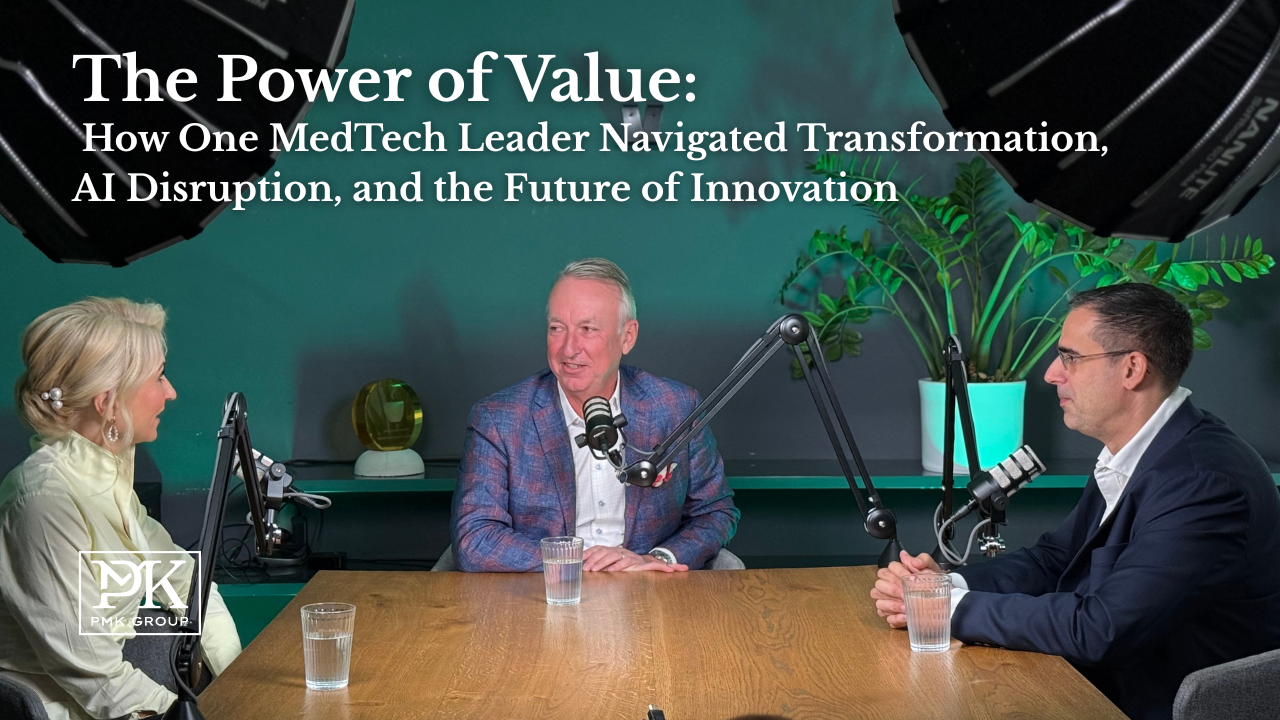
In the world of MedTech and health innovation, there are leaders who follow the waves, and there are leaders who understand how waves are made.
Jiri Pavlicek belongs firmly to the second group.
I’ve known Jiri as a mentor, a founder, a corporate leader, and above all, a man with an unusual clarity about what truly moves markets and people. In our conversation, what struck me most was not only his professional arc from the first Johnson & Johnson employee in post-revolution Czechoslovakia, to CEO, founder, and successful exited entrepreneur but the consistency of the values behind every decision he has made.
This article is not simply a retelling of his journey.
It’s an exploration of a mindset: one that Europe urgently needs if it wants to compete globally in MedTech, AI, and innovation.
Because if you strip away the complexity, one truth remains:
In business and in life, value compounds fastest when it starts with people.
From Communism’s Shadow to Global Leadership: The Mindset That Survived Every System
Jiri grew up in a Czechoslovakia heavily suppressed by a communist regime a world where opportunity was rationed, and ambition was a quiet act of rebellion. His grandfathers, both farmers, were jailed by the regime. Yet they instilled in him something far more enduring than fear: a belief that what sits in your mind can never be taken away.
In a restricted society, education and mindset became forms of freedom.
He learned English before the revolution, and this single competency became the most powerful competitive advantage in the Czech Republic in the early 1990s.
That early principle became a lifelong strategy:
Invest in what compounds the fastest: your capabilities and your integrity.
This clarity is what eventually brought him to Johnson & Johnson as their very first employee in Czechoslovakia. He rose quickly, becoming Managing Director at only 31, overseeing hundreds of employees across Europe and the Middle East. Twenty years later, he would create his own company, Aspironix, build it into a market-leading MedTech distributor, and successfully exit to Asker Group.
But when you ask him what mattered most across all those transitions, his answer is not about profit, market share, or titles.
It’s one word: values.
Values as a Strategy, Not a Slogan
Corporate culture often speaks loudly about values, but operationalizes them poorly. Jiri approaches values differently: not as declarations, but as the primary engine of trust and therefore, of competitiveness.
At Johnson & Johnson, the Credo shaped how decisions were made. In his family, it was the dinner-table values that guided everything else.
In both contexts, the principle is the same:
Trust enables speed. Speed enables performance. Performance compounds into an advantage.
This is more than leadership theory; it’s a strategic differentiator.
When founders ask me why certain startups scale and others stall, it often comes down to this:
They optimize for product before they optimize for people.
Jiri’s advice is simple and universally applicable:
“Make sure you’ve got great people around you. Believe deeply in your product. And never give up. It’s a numbers game.”
Persistence is powerful only when paired with alignment of values, of mission, and of mindset.
And this becomes especially critical when we shift from past experience to the future landscape.
The MedTech Market in Central and Eastern Europe: A Wave Worth Surfing
Global MedTech today is a $600B+ market growing ~5% annually. Europe represents around $150B of that, and importantly, Central and Eastern Europe accounts for $25B, a region that consistently outperforms GDP growth and expands at 6–7% per year.
To use Jiri’s metaphor:
If business is surfing, CEE has the right ocean.
But a surfer needs more than water; he needs:
A big enough ocean → A growing, resilient market
A clear trend → AI, prevention, digital health, remote monitoring
The right board → Scalable innovation and regulatory navigation
Here’s where Europe struggles: we innovate well, but scale poorly.
The Medical Device Regulation (MDR) slowed innovation cycles dramatically. Approval times extended. Costs rose. Early-stage companies were pushed to the sidelines. Meanwhile, the U.S., with its entrepreneurial culture, risk appetite, and funding accessibility, pulled ahead.
This divergence is not theoretical. Jiri sees it firsthand as an investor in multiple startups. The challenge is cultural as much as structural.
Where U.S. founders take bold risks, European founders hesitate.
Where U.S. investors back vision, European investors wait for certainty.
Where the U.S. rewards learning from failure, Europe stigmatizes it.
But here’s the good news:
None of these are permanent disadvantages; they are behavioral patterns we can change.
And the most transformative catalyst of change right now is AI.
AI as the Defining Wave and Why MedTech Cannot Ignore It
If MedTech’s past was defined by minimally invasive procedures, its future will be defined by intelligent care diagnostics, decision support, predictive tools, automation of clinical workflows, and prevention.
A few years ago, Jiri’s team introduced an AI system for reading mammograms. They faced four years of resistance, slow adoption, skepticism, and regulatory friction.
Then November 2022 happened.
OpenAI released GPT to the world, and suddenly, the market flipped overnight.
Demand surged. The conversation changed globally, not just in MedTech, but across every sector.
What previously required explanation now requires no explanation at all.
And Jiri’s perspective on AI is refreshingly pragmatic:
“You must play with it. Use it. Learn from it. Time will show what is good or bad, but as a businessperson, you cannot go without it.”
In surfing terms, AI is not another wave.
It’s the tide that lifts or sinks everything.
But like any powerful force, it comes with risk, especially in early-stage companies. Thousands of AI startups have already failed in the U.S., unable to translate technology into adoption, distribution, or revenue.
How do we mitigate that risk?
Not by avoiding AI, but by applying disciplined execution:
rigorous diligence
strong market validation
clarity of unmet clinical need
realistic adoption timelines
and most importantly,
a leadership team capable of navigating instability
Which brings us back to the heart of Jiri’s philosophy:
You win by who you surround yourself with. AI does not replace leadership; it amplifies it.
The Human Side of Impact: Why Success Still Comes Down to People
For all the strategic insight, global context, and business success, the part of our conversation that stayed with me most was this:
When you ask Jiri what truly drives him now, after decades of achievement, he answers without hesitation:
“Impact on human beings. Making people happy.”
It’s easy to dismiss this as sentimental. It isn’t.
It’s an operational principle, one that explains his entire career trajectory.
People follow leaders who elevate them.
Teams perform for leaders who trust them.
Markets reward companies that commit to human value, not mechanical efficiency.
And in a time where attention spans shrink to goldfish levels, as Jiri referencing Oxford Professor Johann Hari notes, persistence becomes a superpower.
For startups, his advice is blunt and accurate:
“Stay on the topic. Be persistent. Be consistent. Those who stay on will succeed.”
In a world full of distractions, focus is a competitive advantage.
Aspironix and Asker: Building Impact at Scale
After exiting to Asker Group, Jiri still plays an active role in shaping the future. What excites him now is not only the scale that Asker brings, but the alignment of values.
Aspironix is not simply a distributor; it is a value multiplier, a name he intentionally designed to reflect his philosophy. Now, under Asker, the mission is extended, not diluted.
This is exactly how acquisitions should work:
capabilities scale, culture strengthens, impact expands.
Asker’s recent board meeting in Prague confirmed this trajectory. Jiri sees the combined team contributing not just operationally, but intellectually shaping direction and accelerating innovation across Europe.
The legacy he is building is not a company. It is a system of impact.
The Conversation Turns Personal: What Does a Leader Aim for After “Success”?
When asked what he aspires to now, Jiri does not talk about valuations, new ventures, or capital deployment.
He talks about consciousness.
About understanding himself more deeply in order to be more impactful with others. About showing up as a father, grandfather, mentor, and leader with clarity and purpose.
This, in my view, is the next stage of leadership in Europe.
Not louder egos.
Not faster sprints.
But leaders who understand that self-awareness is a strategic asset.
Because when you know who you are, you know how you can contribute and how you can multiply value for others.
What Europe Needs Now: Courage, Curiosity, and Consistency
Throughout our conversation, one theme kept resurfacing: the widening gap in mindset between Europe and the U.S.
Where Europe hesitates, the U.S. accelerates.
Where Europe over-regulates, the U.S. experiments.
Where Europe protects, the U.S. scales.
We can change this, but we must choose to.
Jiri’s final advice to founders and innovators is as simple as it is profound:
“Be curious. Appreciate different perspectives. Align your vision with your soul.”
And for the startup world specifically:
“Stay persistent. Stay consistent. It’s the only way through the disruptions.”
Europe’s competitive future will not be determined by policy alone, or funding, or AI adoption.
It will be determined by whether we cultivate founders who do not drift when the world becomes noisy.
A Final Reflection: Leadership as a Force Multiplier
In every chapter of Jiri Pavlicek’s life, from communist-era childhood to global corporate leadership to entrepreneurship to AI adoption, one element has remained constant:
Leadership is the art of adding value. Multiply that value, and the impact follows.
It’s a philosophy Europe’s innovation ecosystem urgently needs.
Because technologies will come and go.
Regulations will evolve.
Markets will rise and fall.
But the leaders who succeed will be those who:
Surround themselves with exceptional people
Act with clarity and integrity
Embrace risk rather than fear it
Lean into AI instead of resisting it
And persist long after others lose focus
In the end, surfing is not just about reading waves.
It’s about understanding the ocean and understanding yourself within it.
And that is the lesson Jiri leaves all of us:
Keep adding value, stay curious, and never stop learning. The wave is here. The only question is whether we ride it.
Dr. Peter M. Kovacs